Second IEC Activation Heads-up
This information is for IEC participants
The timing when you activate your second work permit can affect your work experience, which matters for some PR streams. The simple takeaway from this post: If you can, activate your new IEC work permit without any gap.
No gap between work permits
- Leave Canada and return before your current permit expires, or at the latest on the expiry date.
- If you plan to activate online, start the process about 6 weeks in advance.
- It’s better to “lose” a few days on your current permit than to lose your job or be forced to stop working.
> Here you can find more information about online activation.
What happens if there’s a gap?
- If there is a gap between work permits, your employer must put you on unpaid leave.
- Not a vacation and no vacation pay should be paid out.
- If you are off work for more than seven consecutive days, your employer must issue a Record of Employment (ROE)
- With the reason “Leave of absence.”
- This is considered an interruption of employment.
- Service Canada receives the ROE, and because it is a government institution, IRCC could have access to it.
- Once you re-enter Canada and activate your new work permit, you can resume work as normal.
An unpaid leave in this scenario is not the same as taking a short vacation while you are still employed and have a valid work permit. A vacation of this kind does not interrupt your employment, whereas an unpaid leave does.
Why this matters for PR
Some PR programs require continuous work experience, meaning even short gaps can affect eligibility. For example:
- Express Entry category-based draws (currently the most likely invitations)
- Any future PR pathways (including expected ones in 2026) that could have a continuous-work rule
- Some Provincial Nominee Programs
What does this mean exactly?
Let’s use a scenario. Here is the wording from IRCC from the category based draws. The screenshot below is from the trade category, or health care, or education.
- After 12 months working in Canada you applied for PR.
- Your skilled work experience was with two Canadian employers.
- At one employer, you had 4 months of experience.
- At your other job, you accumulated 8 months of Canadian work experience in the specific NOC code of that category.
- As a result, you received an invitation from that category based draw, which requires 6 months of continuous work experience.
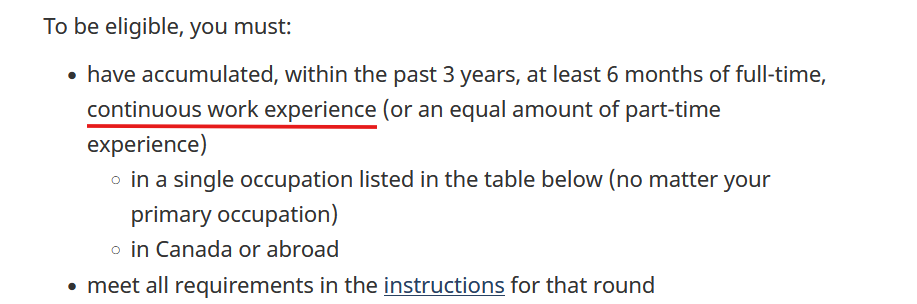
This is a scenario where you could be ineligible:
You started the second job and worked for 4 months. But then you left Canada for a 2-week vacation, and your work permit expired shortly after you left.
When you returned, you activated your new work permit and worked for another 3.5 months.
So in total you worked 7.5 months.
However, the period between the expiry of your previous work permit and the activation of your new one counts as a gap in employment, since you did not have valid work authorization.
As a result, you cannot claim or prove 6 months of continuous work due to this employment interruption.
I am quoting the IRCC requirement for the Canadian Experience Class which explicitly confirms:
Your skilled work experience must be gained by working in Canada while authorized to work under temporary resident status
For PR: No work permit = no legal work = no work experience can be claimed
- For employer 1: 4 months
- Employer 2: 4 months
- Employer 2: 3.5 months
Here is an important recommendation
Flying out (to any country other than the U.S.) and back in is still the safest option for an IEC work permit activation on the exact date. This is how you can make most of your work permit and avoid gaps.
The online activation option could cause major delays, which in turn may put you out of work for longer than expected and could affect your PR chances.
There’s no maintained work status between IEC work permits
If you’re in Canada and need to switch to a visitor record between two IEC work permits due to application delays, you’re technically supposed to quit your job and be rehired once your new work permit is activated.
This is an employer requirement, not from IRCC. In theory, you can’t stay on payroll without work authorization. In practice, many employers place employees on unpaid leave instead. If the unpaid leave lasts more than seven consecutive days, the employer must issue a Record of Employment (ROE).
For permanent residence pathways that require continuous work experience, the end result is the same.
Heads-Up for future PR pathways
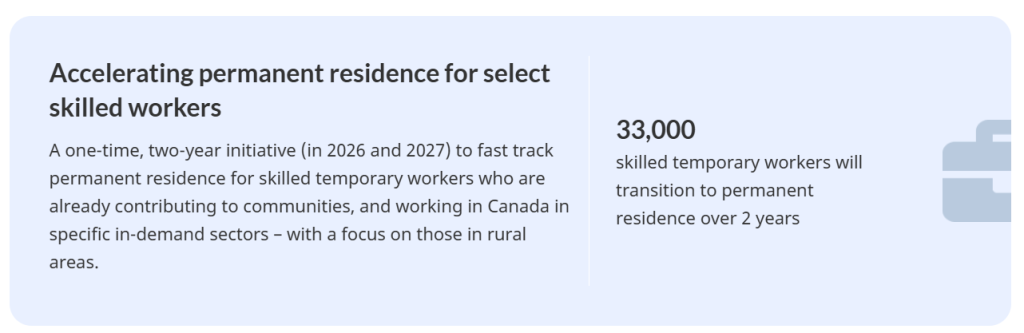
The Canadian government has announced a new permanent residence initiative for 33,000 temporary workers in Canada. However, the specific rules and eligibility requirements have not yet been released. That said, the program could include a requirement for continuous work experience. Here’s the announcement about the new Immigration Plan.
Therefore, if you have the option, plan the activation of your second IEC work permit carefully to avoid any gaps in employment.