Can I extend my IEC Working Holiday?
Scenario 1: When you cannot extend
You cannot extend an IEC work permit beyond the maximum duration allowed under Canada’s agreement with your country.
A Working Holiday work permit is part of Canada’s International Experience Canada (IEC) program.
The maximum length of your IEC work permit depends on your country of citizenship. Each country has its own agreement with Canada that determines how long you can stay and work.
You can check the rules for your country on the official Government of Canada website.
For example, citizens of Australia and Ireland can receive an IEC work permit for up to 24 months, while citizens of Germany and Spain can receive one for up to 12 months.
An IEC work permit cannot be extended beyond the maximum duration allowed for your country. In other words, if you have already received the full duration, you cannot extend your IEC work permit further.
If someone—even an immigration lawyer—tells you otherwise, that information is incorrect. Many professionals aren’t fully aware of the special IEC rules.
To avoid misunderstandings, below are the official Government of Canada rules. If a lawyer or consultant gives different advice, feel free to share the official link so they can double-check the correct information at the source.
As a rule, no work permit extensions are authorized under the International Experience Canada (IEC) Program.
The validity period for an IEC work permit may not exceed the maximum length of stay authorized under the bilateral agreement or arrangement.
Official government Source
The validity period for an IEC work permit may not exceed the maximum length of stay authorized under the agreement/arrangement
Official government Source
Categories of work with validity periods that may not be exceeded: International Experience Canada programs
International Experience Canada programs Paragraph R205(b), exemption code C21:The work permit cannot extend past the period specified in the country agreement.
Official government Source
Be careful with IEC extension advice
Many unsupervised social media websites and even questionable lawyers suggest applying for an IEC extension to obtain maintained status so you can keep working. However, this is considered illegal advice.
Official government Source
Applications for work permits in the IEC Program are always submitted “outside of Canada” and therefore do not meet the requirements for maintained status for an extension of stay under subsection 183(5) of the Immigration and Refugee Protection Regulations (IRPR).IEC work permit applications do not meet the requirements for work without a permit under paragraph R186(u) either.
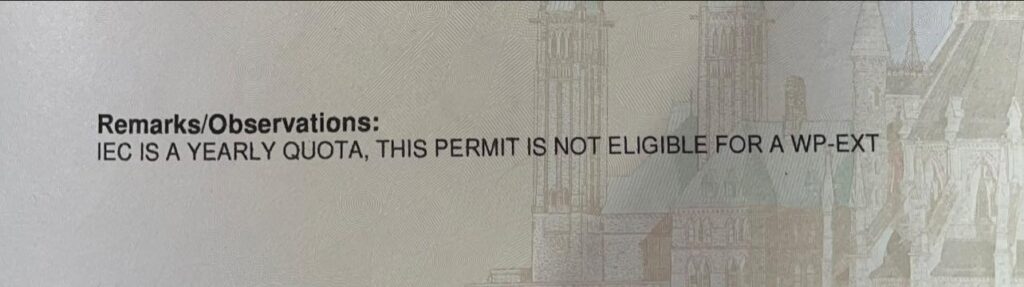
Some border officers may add a note to the bottom of your work permit stating that the IEC work permit cannot be extended. This means that once your permit expires, you cannot extend your stay using the same IEC work permit.
You cannot apply for a “blank” open work permit
There is no “blank” open work permit that you can apply for just to stay and work in Canada. You need to qualify under a specific immigration program or work permit category, such as an LMIA-based or LMIA-exempt work permit.
If you apply for a work permit you are not eligible for, your application will be refused. This can affect your status and your ability to work after your IEC permit expires.
Be very careful if someone tells you to submit a fake application just to get maintained status.
If you knowingly provide false or misleading information in an immigration application, this can be considered misrepresentation under Canadian immigration law. Misrepresentation is very serious. It can result in removal from Canada and a 5-year ban.
Don’t risk your future in Canada just to keep working a few extra months. Make sure you are actually eligible for the work permit you are applying for.
What happens if you work after your IEC expires?
If you apply for a work permit you are not eligible for and keep working after your IEC permit expires, you are working illegally. This can cause problems with future work permit or permanent residence applications.
You must disclose previous work permit refusals on future immigration applications. Depending on the circumstances, a refusal or illegal work could affect your future plans in Canada.
And it’s not just Canada you need to think about. Other countries may also ask about previous visa or immigration refusals. For example, if you later apply for a Working Holiday in Australia, you have to disclose your Canadian refusal, and it could affect your application.
Don’t take the risk. If you want to stay in Canada after your IEC permit expires, you can either:
- Apply for another work permit you are eligible for, or
- Apply for a visitor record to stay in Canada as a visitor.
Did you know some countries share immigration information?
Australia, Canada, New Zealand, the United Kingdom and the United States cooperate closely on immigration and security matters. It is called the “Five Eyes”.
This means that immigration information can be shared between these countries in certain circumstances. Depending on the situation, this can include information about:
- Visa or immigration refusals
- Overstays
- Deportations or removals
- Travel and immigration history
Don’t assume that an immigration refusal or violation in one country will stay completely separate from your future applications in another country.
Scenario 2: When you can extend
In three situations, you can extend the IEC work permit to the maximum allowed length under the agreement with your country. You can never extend it beyond that maximum.
The only three circumstances where you can extend your IEC work permit:
- Mistake at the time of activation:
- If the immigration officer made a mistake and issued your work permit for less time than you are entitled to. This is the most common mistake that you should try to fix on the spot with the officer.
- If the immigration officer made a mistake and issued your work permit for less time than you are entitled to. This is the most common mistake that you should try to fix on the spot with the officer.
- Passport validity:
- Your passport was not valid for long enough when the work permit was activated and therefore a shorter work permit was issued to match the validity of the passport.
- Young Professional category:
- If the employer created a shorter job offer and therefore a shorter work permit was issued.
If you are in one of the above three situations, > here < is the info on how to extend the work permit.
Scenario 3: Health insurance
If your IEC work permit was cut short because of health insurance, you cannot extend it.
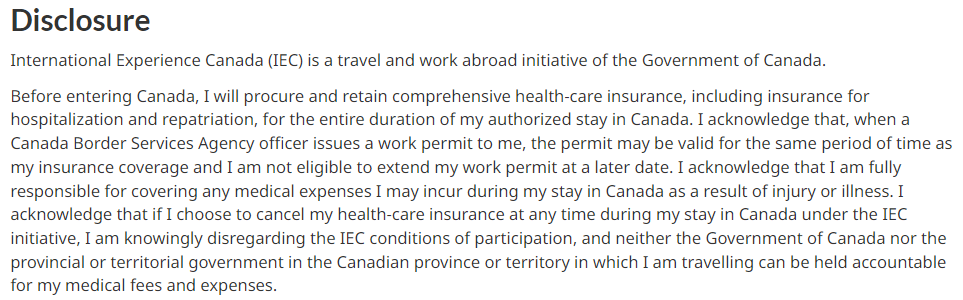
If your IEC work permit was shortened because your health insurance did not cover your entire stay, you cannot extend the IEC work permit later.
When you activate your IEC work permit, your health insurance must cover your entire intended stay in Canada.
If your insurance only covers a shorter period, your work permit will be issued for that shorter period. You cannot extend it later to make up the difference.
For example, if you have insurance for only 6 months, your IEC work permit will be issued for only 6 months. You cannot buy additional insurance later and apply for an extension.
Official source 1:
- IRCC does not allow the client to submit an application to extend the period of their participation to reach the full maximum duration allowed under the bilateral agreement or arrangement.
- The applicant failed to obtain travel insurance that fully covers their anticipated stay, as stipulated in their letter of introduction; therefore, their work permit application is automatically refused.
- The IEC participant cannot increase the validity period of their work permit. If they receive a work permit with a shorter validity period due to the length of their insurance coverage, they are not eligible to apply to increase the validity period of their work permit at a later date.
Official source 2:
- If the participant’s health insurance is not valid for the entire period of the work permit being sought, the duration of the work permit must be shortened to match the validity of the health insurance.
- […]
- If the client receives a shorter work permit due to the length of their insurance policy, they are not eligible to apply for an extension at a later date.
Official source 3:
Before you submitted the application you had to electronically sign a disclosure with the information about the health insurance. There is no excuse with “I didn’t know”.
Scenario 4: Another IEC participation
A new IEC participation via the IEC pools is not considered an ‘extension’, it is a completely new work permit.
A few of the IEC countries allow a second Working Holiday participation. Italy, the United Kingdom, Croatia, and Chile are some of the countries that allow it. Enter your country >> here << to read the offered categories and their requirements.
Other countries also offer a second participation via the Young Professional category of the IEC program. Find out more >>here<< about this category.
You can also do another Working Holiday through a Recognized Organization. This is considered a new application, not an IEC extension—even if this new permit lets you stay longer in Canada.
One important thing: There is no maintained status between two IEC participations.
If you apply for another IEC and your current work permit expires while you wait for your new application, you must stop working and apply for a visitor record to stay in Canada legally.
The visitor record costs $100, and you can apply online through your GCKey account.
You cannot work while you wait. You can start working again only after you activate your new IEC work permit.

When does maintained status actually apply for IEC participants?
You can keep working legally in Canada after your IEC work permit expires only if all of the following conditions are met:
You applied for a new work permit before your IEC work permit expired.
→ Your new application must be submitted and received by IRCC before the expiry date.You are eligible for the new type of work permit.
→ You must meet all requirements for the new category you’re applying under (e.g., job offer, LMIA, PR status, etc.).You applied for a work permit that is not part of the IEC program.
Examples include:An LMIA-based work permit (supported by a Labour Market Impact Assessment)
An LMIA-exempt work permit (for example, under a trade agreement or spousal open permit)
A PR-related open work permit (like the Bridging Open Work Permit)
You can find more information about maintained status >> here <<