Repeat IEC participants in Canada
Important things to know for the IEC process
If you’re in Canada and applying for a second IEC participation, whether with the same citizenship, a different citizenship, or a Recognized Organization (RO), there are a few important things to keep in mind to ensure the process goes smoothly.
Only enter the Young Professional pool if you are eligible for it.
Some IEC countries offer the Young Professional category, which is a closed work permit and where a job is a requirement.
Entering the wrong pool is a common mistake from repeat IEC participants or those who already have a job lined up in Canada. This mistake can delay your application big time.
The Young Professional category has strict requirements, and you may not qualify.
Under the Young Professional (YP) category:
- The job must be a skilled job in TEER 0–3.
- Your employer must register in the Employer Portal and submit your job offer there.
- Then the employer must pay a $230 compliance fee.
- You will be tied to this employer for the full duration of your work permit.
- Changing employers is only possible in certain circumstances out of your control.
- You are not allowed to have another job beside this.
- You cannot change job duties, for example accepting a promotion with the same employer.
Why is this so important?
If you enter both the Working Holiday and Young Professional pools, the system prioritizes Young Professional invitations first. This means you’ll receive an invitation from the Young Professionals pool.
Once this happens, your profile is blocked from receiving invitations from other categories. Even if you’re also in the Working Holiday pool, you won’t get an invitation from there.
Declining a Young Professional invitation in hopes of getting a Working Holiday invitation won’t work. As long as there are spots available in the Young Professionals pool, you’ll only receive invitations from that pool.
What to do if you want a Working Holiday (open work permit)
Option 1:
When you create your profile, answer 'no' to the job offer letter question.
A job and an employer is not a requirement for the Working Holiday because it is an open work permit. If you’re applying for another Working Holiday but already have a job, you should answer “No” to the job offer question — even if you’re currently employed or have a job lined up in Canada.
First, answering “Yes” could accidentally place you in the Young Professionals pool, which may not be what you intend.
Additionally, after receiving an invitation, selecting “Yes” will require you to complete extra fields about your employer and job. These details are not required for the Working Holiday category and can be avoided by answering “No” to the job offer letter.

Option 2:
When you create your profile, at the end answer 'no' to the question if you would like to be added to the YP pool.

If you received an invitation from the Young Professionals pool but your goal was a Working Holiday, you’ll need to start over because your profile received an invitation from the wrong pool. Unfortunately, there’s no way to bypass this. Here are the steps:
- Decline the invitation from the Young Professionals category.
- Delete your current profile from the IEC pool.
- Create a new profile in the same GCKey Account by starting a new application with the questionnaire.
- Answer “No” when asked about a job offer or select only the Working Holiday category to re-enter the Working Holiday pool.
- Then wait for a new invitation for the Working Holiday category.
Countries with a residency requirement
The following IEC countries have a residency requirement:
Countries with a discontinuance requirement
The following IEC countries have a discontinuance requirement:
This means there must be a break between the expiry of your first IEC work permit and the date you can apply for a second one. As a result, you can only submit a new application after a required waiting period. Here are the required breaks:
- Croatia: 3 months
- Latvia: 1 year
- Lithuania: 3 months
- Poland: 6 months
- Slovakia: 3 months
- Spain: 3 months
Passport
A work permit will not be issued past the expiry of your passport.
For example, if you activate your new IEC work permit and your passport expires in eight months, then you will receive a work permit valid for only eight months, rather than the full 12 or 24 months permitted for your country.
What you should do:
- Renew your passport before applying, and use the new passport for your application.
- By using a new passport, you can avoid having to update documents or apply for extensions later.
- This also ensures that your POE, and your eTA, are correctly linked to your new passport.
Biometrics
Do I have to give biometrics again?
Good news. If you gave biometrics for another Canadian work permit application, they are valid for 10 years and can be used for all future temporary resident applications.
During the application process, you will answer “yes” to the question about whether you’ve given biometrics. Additionally, once you submit the application, they will automatically be assigned to your profile within a few days.
If you’re unsure whether your biometrics are still valid you can check > here < . If they show ‘expired’ then the processing agent will request new biometrics.
Police certificates
Can I re-use the police certificates from the first IEC application?
This will depend. Here the general rules:
➡️ First check: Is the police certificate under 6 months old? > You can use it.
➡️ Second check: Is the police certificate over 6 months old? Then this applies to you:
- If the police certificate was issued while you were still in the country > you need a new one.
- If the police certificate was issued after you left the country, but you were back to that country > you need a new one.
- If the police certificate was issued after you left the country, but have never been back > you can re-use it
❗️In other words: Police certificates are valid indefinitely and can only be re-used, if:
- they were issued after you left that country and
- you have never been back to that country (not even for a few days to visit).
The graph below helps you decide and applies to the time when you submit your IEC work permit application.

When I activate my work permit, my police certificate will be older than 6 months
If your police certificate is older than six months when you activate your work permit, that’s okay. Once you’ve received your POE (approval), you do not need a new certificate — you can use the same one you uploaded with your original application.
I spent more than 6 months in Canada; do I need a police certificate from Canada?
No, a police certificate from Canada is not required. This is because Canada conducts its own background checks. Therefore, a certificate from Canada is only needed if IRCC specifically requests one after you have submitted your application.
IEC health insurance
Do I need IEC health insurance again?
Yes. When activating an IEC work permit, you always must have a health insurance that must be valid for the entire length of your intended stay in Canada (the length of the work permit). Additionally, if you are already in Canada, be aware that you will need an “already travelling” insurance policy.
Your IEC health insurance must cover:
- medical care
- hospitalization and
- repatriation (returning you to your country in the event of severe illness, injury or death)
If your insurance policy is valid for less than your expected stay, then you will receive a work permit that expires at the same time as your insurance. If this happens, you will not be able to extend your work permit later.
I am already in Canada and have provincial health care
If you have provincial health care or employer-provided benefits, they are not enough for your IEC activation. This is because provincial health insurance doesn’t cover repatriation to your home country, and likewise, employer benefits don’t cover it either.
The best IEC health insurance for European and UK citizens
recommended by other IEC participants who used them

If you are not from Europe, check out > BestQuote
Other info and common questions
IRCC might request additional information
After you submit your application, a processing officer may request additional or updated documents, such as a new police certificate, and will then provide a new deadline. Once you upload the requested document, be sure to click “Next” all the way through until the document status shows “Replacement provided.”
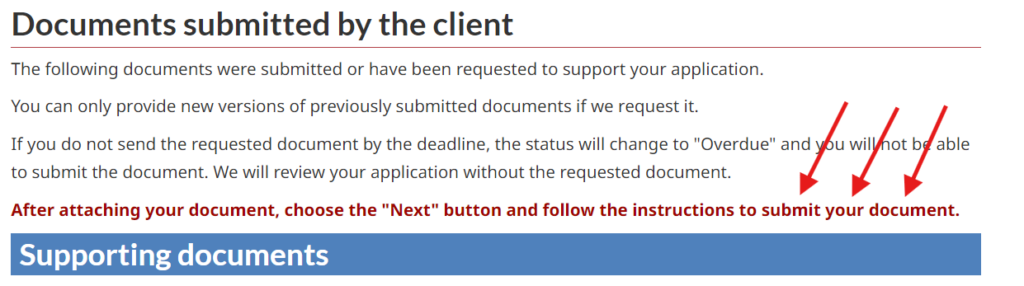
If you don’t complete all the steps, you will receive a refusal, because you didn’t submit the document — it’s like writing a letter but never mailing it.
To avoid this, follow all the steps from the first link >> on this page << to find the upload spot and how to submit the document.
In the new request for a police certificate, the upload form will ask for some details:
- If the certificate doesn’t have an expiry date, enter a date at least one year after it was issued.
- If the certificate doesn’t have a document number, simply enter N/A in the field.
I am in Canada; can I keep working while I wait for the new IEC?
There is no maintained status between two IEC participations.
To stay in Canada legally after your first IEC, you must apply for a visitor record before your current status expires.
- The visitor record costs $100.
- You can apply online using the same GCKey account. Just start the application and complete the questionnaire.
- Once your current work permit expires, you will be in maintained visitor status, which allows you to stay in Canada until a decision is made on your visitor record application or until you activate a new work permit — whichever comes first.
- You will receive the visitor record by post, so you do not need to visit the border to activate it.
- Remember: once your work permit expires, you must stop working until your new work permit is activated.
For more detailed information about the visitor record and many additional questions, click > here <

When I activate the second IEC work permit, do I need all documents again?
Yes. When you activate any new IEC work permit (first or second), you must bring paper copies of all supporting documents.
Prepare the following documents for activation (border officers will typically focus on the IEC health insurance):
- Passport
- POE Letter of Introduction
- Proof of funds (minimum $2,500)
- Proof of valid health insurance for entire stay
- Return ticket or funds sufficient to purchase one
- Printed copies of all documents you submitted with your IEC application (police certificates, resume, family form, etc.)
I am already in Canada. Can I activate the work permit at the US border via flagpoling?
No. The Canadian government ended flagpoling on December 24, 2024. The announcement can be found > here <. Due to this change, a short visit to the USA is not an option either, because this is how the government defines ‘flagpoling’:
“Flagpoling occurs when foreign nationals who hold temporary resident status in Canada, leave Canada and, after a visit to the United States or St. Pierre and Miquelon, re-enter to access immigration services at a port of entry.”
Many IEC participants have a short trip to Mexico and back. Or they use the opportunity to visit their family at home and then activate the work permit on the way back to Canada.
Can I activate the IEC work permit without leaving Canada?
Yes, you can activate the second IEC work permit online. However, you must meet all 3 requirements mentioned here.