How to Find a Job in Canada on an IEC Working Holiday
Finding a job in Canada on an IEC Working Holiday can feel overwhelming, especially if you are new to the country. In this guide, you’ll find practical tips on how to find jobs in Canada, prepare a Canadian-style resume and improve your chances of getting hired.
>> See what else you need to do before your Canadian adventure.
Tips on how to prepare a good resume

In many countries, you may know it as a CV. In Canada, it is called a resume.
Before you start applying for jobs, prepare a Canadian-style resume. Your resume may look different from the one you use in your home country, so it is worth checking Canadian examples and templates before you start sending applications.
There are many Canadian resume templates available online that you can use as a starting point.
For example, in Banff, the Job Resource Centre offers free, personalized help with your resume. You can visit their office for one-on-one advice, help with job applications and access to local job listings.
A few basic rules for your Canadian resume
- Use a Canadian phone number once you have one.
- Keep your resume short, clear and easy to read.
- For most jobs, one page is ideal, while two pages should be the maximum.
- Tailor your resume to each job.
- Only include work experience that is relevant to the position.
- Highlight your skills and experience that match the job description.
For example, if you are applying for an office job, you don’t need to list every babysitting job you’ve ever had. Focus on the experience and skills that are relevant to the position.
What NOT to put on your resume
You should not include personal information, such as:
- Your age or date of birth
- Your ethnicity or cultural background
- Your marital or family status
- Your sexual orientation
- Unless you’re applying for a job as a model or actor, leave the photo out.
In Canada, information such as your photo, age or date of birth can create discrimination concerns during the hiring process. Including a photo or date of birth on your resume can work against you and may reduce your chances of getting an interview.
Your resume is there to show employers what you can do — not what you look like.😉
- Never include your Social Insurance Number in your resume.
Your SIN is private information and is not needed when applying for a job. You only need to provide it to your employer when you are hired, as it is required for payroll.
References
- Don’t list your references directly on your resume.
Employers ask for references later in the hiring process if they are seriously considering you.
Instead, you can simply write: “References available upon request.”
And here is something many travellers don’t know: a reference doesn’t necessarily have to be a previous employer.
Depending on the job, a reference could also be a former coworker, roommate, landlord, family member or friend — basically anyone who knows you well and can say something positive about your work ethic, reliability or personality.
Yes, even your old roommate who can confirm that you actually paid the rent on time. 😄
So don’t worry if you have only recently arrived in Canada and don’t have a long list of Canadian employers. You may already have people who can vouch for you.
Use a professional email address
If you are using an email address from your home country not ending in .com, especially one with a less familiar domain such as Yahoo, Web, Hotmail, Gmx, automated email systems may filter messages into the spam folders.
You don’t want your perfect job offer hiding in the spam folder.
It is a good idea to create a Gmail address just for your job search. It is free, simple and professional.
Keep your email address easy to read, ideally something like firstname.lastname@gmail.com.
Avoid using funny or unusual email addresses when applying for jobs. Your future employer may remember happycow123@gmail.com, but it probably won’t make the best first impression for a job. 😉
Use keywords from the job posting
Don’t just copy and paste the job description. Read the job posting carefully and mention the skills and experience that match the position. Use relevant keywords naturally in your cover letter, but only include things that are true about your experience.
Some employers use software to screen applications, so using the right keywords can help your application get noticed.
Keep it short and easy to scan
Employers spend only a few seconds looking at a resume and cover letter. Make your most important skills, experience and qualifications easy to find. Keep your cover letter short and avoid long paragraphs.
You only get a few seconds to make a first impression — make them count.
Where to look for jobs in Canada

One of the easiest ways to start is by using online job websites. Some of the most commonly used job websites include:
- Indeed.ca
- SimplyHired.ca
- The Canadian Government Job Bank
You can also attend job fairs, industry events and workshops offered by newcomer support organizations. Sometimes a personal connection can help you get an interview much faster than sending dozens of online applications.
Check company career pages
Don’t rely only on job boards. Many companies post jobs directly on their own websites and may not advertise every position on Indeed or other job sites.
Make a list of companies you would like to work for and check their Careers pages regularly.
It can also pay to know someone who already works there. Many companies have employee referral programs, so a recommendation from an existing employee can sometimes help get your application noticed.
Use an employment centre in Canada
You don’t have to figure it all out yourself. Canada has employment centres that offer free, personalized services to help you find work.
Depending on the centre, you can get help with writing your resume, preparing for interviews, finding job openings and improving your skills.
There are hundreds of employment centres across Canada, so it’s worth checking what is available in the area where you plan to live.
Network whenever you can
Did you know that many jobs in Canada are never publicly advertised? This is why networking can be so useful.
Create a strong LinkedIn profile and connect with people working in your industry.
Tell friends, roommates, coworkers and other people you meet in Canada that you are looking for work. Join local Facebook groups and connect with people.
Even a casual conversation over a beer at a pub can sometimes lead to a job opportunity.
Try Meetup
Meetup can be a great way to meet people and expand your network. Join groups based on your hobbies and interests, and while you’re there, let people know you’re looking for work.
You get to do something you enjoy, meet new people and maybe even hear about a job opportunity.
You might go there for the hobby and leave with a job lead.
Start your job search early

You can start looking for jobs before you arrive in Canada. This is especially helpful if you already know where you want to live.
However, getting hired from outside Canada can be more difficult because employers receive applications from people who may not have the right to work in Canada.
If you are coming to Canada through the IEC program, make your work authorization clear. Mention your IEC work permit or POE letter of introduction in your resume or cover letter.
If you are applying before you arrive, also include your arrival date and when you can start working.
If you get an interview, the employer may ask about your right to work in Canada.
Be ready to explain your work permit, how long it is valid and when you can start working. If you have an IEC Working Holiday work permit, you can also explain that it allows you to work for different employers in Canada.
If you plan to arrive during the season
Finding a job in the middle of the tourism season can be a little harder, but it is still possible. Tourism businesses often have employees leaving during the season, so new jobs can become available.
Many employers are looking for people who can start quickly. If you are applying from outside Canada, tell them when you will arrive, when you can start and that you are legally allowed to work in Canada.
Make it easy for the employer to see when you are available and ready to work.
Seasonal jobs can be a great option
One of the biggest advantages of an IEC work permit is the flexibility to travel and work in different parts of Canada.

Seasonal work can be a great option if you want to work and travel at the same time.
Ski resorts hire many workers for the winter or summer season. Hotels, restaurants, national parks and other tourism businesses also offer seasonal jobs.
You can find work in hospitality, housekeeping, restaurants, customer service, ski lifts, rentals, retail and outdoor activities.
Ski resorts in Canada
If you would like to spend a winter working in the mountains, check the career pages of ski resorts directly.
Here are some places to check:
- Lake Louise
- Banff
- Banff + Jasper
- Banff + Canmore
- Castle Mountain
- Kicking Horse Mountain Resort (Golden)
- Panorama Resort (Invermere)
- Whistler
- Whistler’s Job Board Facebook Group
- Sun Peaks
- Big White
- Whitewater Ski Resort (Nelson, BC)
- Red Mountain
- RCR (Fernie, Kicking Horse, Kimberley and Nakiska)
- Revelstoke
- Silver Star
- Manning Park Resort
- Washington (Vancouver Island)

Imagine telling your friends back home that your commute involves a ski hill.
Getting paid to work in the mountains and getting a ski pass? Not a bad deal.
Working at a ski resort can come with some great employee benefits. One of the biggest benefits is a free or discounted ski pass. This means you can ski or snowboard on your days off without paying the full price of a season pass.
If you love winter sports, a ski resort job can be a great way to earn money while enjoying the mountains.
Benefits are different at each resort, so check what is included before accepting a job. Some resorts also offer discounts on equipment, food, accommodation and other activities.
Think about accommodation before accepting a seasonal job
If you are planning to work at a ski resort or in a popular tourist destination, make accommodation a priority when looking for a job.
Finding a place to live can be difficult in towns like Whistler, Banff, Canmore and other mountain communities. If staff accommodation is available, this can make things much easier.
If the resort offers employee housing, ask about it as early as possible and find out:
- whether accommodation is guaranteed or limited
- how much it costs
- whether utilities are included
- what type of accommodation is provided
- how many people share the accommodation
- when you can move in
- what happens if you leave the job
Apply to several jobs
Do not wait for one employer to respond before sending another application. And don’t sit by the phone waiting for that one employer to call. Keep applying.
Job searching can take time, and employers receive many applications. Apply for several suitable positions and keep track of where you have applied.
If you do not hear back, do not automatically assume that you were not qualified. It is very common in Canada for employers not to send a rejection email. They may only contact candidates they want to invite for an interview.
Don't be afraid to walk in
When looking for work in a small tourist town, don’t rely only on online applications. Walking into hotels, restaurants and other businesses and handing your resume to a manager can be a great way to find work.
Dress neatly, be friendly and ask if the manager is available. Meeting someone in person can help you stand out and make a good impression.
Sometimes, the old-fashioned way still works — and you could even find a job quickly!
If you don’t hear back, follow up. After a few days, you can call the business and politely ask if they had a chance to review your resume.
Your first Canadian job doesn't have to be perfect
Finding a job at the same level as your previous position can be difficult when you first arrive in Canada, especially if your experience is from another country.
One option is to start with a lower-level or entry-level job in your field. It may not be your ideal position, but it can help you gain Canadian work experience and learn how things work in your industry.
For example, if you worked in office management before, you could start as an administrative assistant or receptionist. After gaining some Canadian experience, you can use it to apply for higher-level jobs.
Think of your first Canadian job as a stepping stone to your next opportunity.
Temporary jobs can also help
Another option is to register with a temporary employment agency. These agencies connect workers with Canadian employers looking for temporary or short-term help.
This can be a good way to get Canadian work experience, earn money and meet employers while looking for a permanent job.
Sometimes, a temporary job can even become permanent if the employer is happy with your work.
Your first Canadian job can be a great way to get your foot in the door.
Volunteer
Volunteering can be a great way to gain Canadian experience. Even if the position is unpaid, you can learn new skills, meet people and add valuable experience to your resume.
It can also make a great impression on your resume and could even open the door to a paid position with the same organization.
Sometimes getting your foot in the door is the hardest part.
Keep learning
Use your time in Canada to learn something new or further your knowledge. Online courses, workshops and seminars can help you improve your skills and make your resume stronger.
And who knows — that little extra course might be the thing that gets your resume noticed.
A final tip about AI and applications
Your job application should sound like you. AI is a great helper. Just don’t let it become the person applying for the job.
AI can help you write or improve your resume and cover letter, but don’t simply copy and paste an AI-generated application. Some employers use software to screen resumes, so your application may never reach a person.
Use your own experience and words, and make sure your resume matches the job you are applying for.
Beware of Job Scams
Be careful when applying for jobs online. Unfortunately, job scams do exist in Canada, and newcomers can be an easy target.
Some warning signs include:
- The employer only communicates through messaging apps
- and avoids a proper interview or company email.
- The job sounds too good to be true,
- especially if the pay is unusually high for the position.
- You are offered a job without a proper interview
- or without speaking to anyone from the company.
- The job posting does not appear on the company’s official website
- or you cannot verify that the company is real.
- You are asked to provide sensitive personal information too early,
- such as your SIN, passport or banking details.
- You are asked to pay money to get the job.
- A legitimate employer should not charge you for being hired.
- You are asked to buy equipment or send money,
- with the promise that the company will reimburse you later.
If something feels wrong, take a step back and check the company before providing any personal information or money.
And remember: if a job sounds too good to be true, it probably is.
Know your rights as a worker
As an IEC participant, you have rights as a worker in Canada. Your employer must follow Canadian employment laws, including rules about wages, working hours and workplace safety. You also have the right to keep your passport and work permit — your employer cannot take them away from you.
>> Learn more about your rights as a temporary foreign worker in Canada and how to get help.
Frequently Asked Questions About Finding a Job in Canada

Do I need a job to activate my IEC Working Holiday work permit?
No. You do not need a job offer to activate an IEC Working Holiday work permit.
When you arrive in Canada, you can activate your work permit at the border by presenting the required documents, including your passport, POE letter of introduction, proof of health insurance and proof of funds.
Once issued, your Working Holiday work permit is an open work permit, so you can look for a job after you arrive and work for different employers.
>> Here are the documents you need for the work permit activation.
How long can I work for the same employer on an IEC Working Holiday?
If you have an IEC Working Holiday open work permit, there is no limit on how long you can work for the same employer. Unlike some other Working Holiday countries, such as Australia, Canada does not require you to change employers after a certain period.
You can stay with the same employer until your work permit expires, unless you get another valid work permit in Canada.
Can I have more than one job on an IEC Working Holiday?
An IEC Working Holiday open work permit allows you to work for different employers, so you can have more than one job.
For example, you could work at a ski resort and have a part-time job at a restaurant.
Can I work as a freelancer or self-employed person on an IEC Working Holiday?
If you have an IEC Working Holiday open work permit, you can work for different employers and can also work as a freelancer or self-employed person.
The IEC Young Professionals work permit is different. It is tied to one specific employer, so you cannot work for another employer or be self-employed.
>> Here you can find more information about working as a freelancer on an IEC Working Holiday.
Can I work remotely for a company outside Canada while on an IEC?
In general, yes. However, working remotely for a company outside Canada can make your taxes more complicated. Depending on your situation, you may have tax obligations in both countries.
If you plan to work remotely while living in Canada, it is a good idea to speak to a CPA who specializes in cross-border taxes and tax treaties. A regular tax preparation service may not have the experience needed for this type of situation.
When tax time comes, search for “cross-border tax CPA” + the province where you live. They may cost more, but they can help you understand the tax rules in both countries and avoid expensive mistakes.
Can I find a job in Canada before I arrive?
Yes. You can start applying before you arrive, particularly if you already know where you want to live. Make your IEC work authorization and planned arrival date clear to employers.
However, getting hired from outside Canada can be more difficult because some employers prefer candidates who are already in Canada with an activated work permit.
Can I travel in Canada on an IEC Working Holiday without getting a job?
Yes. You do not have to work in Canada just because you have an IEC Working Holiday work permit. If you have enough money to support yourself, you can spend your Working Holiday travelling around Canada and only work if and when you want to.
In the community, many people rightly refer to the program as “Work and Travel.” And the official name is “Working Holiday” for a reason! 😉
Can I get a job without a Canadian bank account?
Yes. You can apply for jobs and get hired before opening a Canadian bank account. Once you start working, you will need a bank account to receive your salary. Most employers pay their employees by direct deposit.
The good news is that many Canadian banks offer free newcomer bank accounts, so opening an account when you arrive is usually quite easy. For example, CIBC has branches in many locations across Canada.
Do I need a SIN before I can work in Canada?
Yes. You need a Social Insurance Number (SIN) to work in Canada and receive employment income.
You should apply for your SIN as soon as you have activated your work permit. You cannot apply for a SIN before your work permit is activated. You will need your passport and your activated work permit to apply.
Never put your SIN on your resume or send it to an employer as part of a job application. They only need your SIN after you are hired.
Can I get a job in Canada if I don't speak fluent English or French?
It depends on the job. You don’t need perfect English or French for every job in Canada. Many seasonal jobs in hospitality, housekeeping and tourism may have more relaxed language requirements, while jobs where you communicate directly with customers may require stronger English or French skills.
Be honest about your level of English or French when applying, and look for jobs that match your skills.
When does the tourism industry start hiring in Canada?
The timing varies depending on the season and location. For the winter season, many ski resorts and tourism businesses start hiring several months before the season begins.
For example, the Lake Louise Ski Resort recruitment for winter will begin around August/September, while Whistler Blackcomb already had winter positions posted in July, showing that some resorts start considerably earlier.
If you are looking for summer jobs in ski resort towns, applications can start as early as February.
Do I need Canadian work experience to get a job in Canada?
No. Canadian work experience is not required for every job. However, having local experience can make it easier to find higher-level positions. An entry-level or temporary job can be a useful way to gain Canadian experience, references and contacts.
Can I work in any job in Canada with an IEC Working Holiday?
If you have an open IEC Working Holiday work permit, you can work for different employers and in most types of jobs in Canada. However, there is a restriction printed on the bottom of the work permit:
“Not valid for employment in businesses related to the sex trade such as strip clubs, massage parlours or escort services.”
This restriction applies to all IEC participants. It is a mandatory condition and cannot be removed from the work permit.
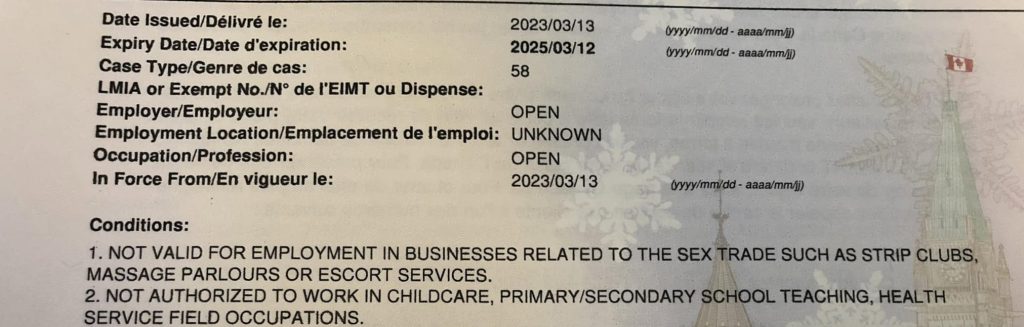
There are also restrictions if you want to work in certain occupations. For example, if you want to work in health care, child care or elderly care, you need to have completed the required medical exam as part of your IEC application. This allows you to receive a work permit without this restriction so that you can work in these fields.
You can find more information about the IEC medical exam here.
How long does it take to find a job in Canada?
There is no fixed timeframe. It depends on your location, industry, experience, season and the number of jobs available. Applying to several suitable positions rather than waiting for one employer to respond can improve your chances of finding work faster.
Don’t get discouraged if you don’t hear back right away. Some IEC participants report sending out 50–100 applications before getting one or two interviews. It can take time, so keep applying and don’t take a rejection — or no response at all — personally.
How much money should I bring to Canada if I don't have a job lined up?
It is a good idea to have some savings in case you don’t find a job straight away.
For an IEC Working Holiday, you need to show at least CAD $2,500 in funds when you arrive, plus enough money for your return flight. However, this is only the minimum requirement.
If possible, try to save enough to cover 2–3 months of living expenses while you look for work. This should cover things like accommodation, food, transport and other basic expenses. Many IEC participants recommend arriving with at least CAD $10,000 in savings.
The amount you need will depend on where you are staying. Living in a mountain or tourist town can be expensive, especially if you need to pay for your own accommodation.
The more savings you have when you arrive, the more time you have to find the right job without feeling rushed.
If I find a job and get provincial health care, do I still need IEC insurance?
Yes. You must keep your IEC health insurance for the entire period required by your IEC work permit, even if you have provincial health care or health insurance benefits through your employer.
Provincial health care and employer health benefits do not replace the insurance required for IEC participants. Your IEC insurance must include coverage for the entire duration of your stay, including repatriation.
Important: If you arrive in Canada with insurance that covers only part of your planned stay, your work permit will be issued only until the expiry date of your insurance.
>> Find more answers to frequently asked questions about IEC health insurance requirements here.
The best IEC health insurance for European and UK citizens
recommended by other IEC participants who used them

If you are not from Europe, check out > BestQuote