Spousal Open Work Permit (SOWP) for IEC Participants in Canada
On January 21, 2025, the rules for the Spousal Open Work Permit (SOWP) changed significantly.
This guide focuses specifically on spouses and common-law partners of International Experience Canada (IEC) participants, including those in the Working Holiday category.
IEC and SOWP: Common scenarios for couples
If you and your partner meet one of the following, you can read on
One partner is over the IEC age limit.
Example: One partner is 37 years old and no longer eligible for IEC because they exceed the age requirement.
Only one partner receives an IEC invitation.
The IEC is a lottery and only one partner is selected from the IEC pool, while the other is not.
One partner has a longer IEC work permit.
Example: An Australian citizen receives a 2-year work permit, while a German citizen receives a 1-year work permit. The German partner may apply for a SOWP to match the length of the Australian partner's permit.
One partner has dual citizenship and can participate in IEC again.
A person who has already used the IEC under one citizenship can participate again using their second citizenship.
One partner's citizenship is not eligible for IEC.
One partner comes from a country that does not participate in the IEC program.
Common questions for IEC participants

What is a Spousal Open Work Permit (SOWP)?
In short, a SOWP is an open work permit issued under Canada’s International Mobility Program (IMP). It allows the spouse or common-law partner of a temporary worker to work in Canada without needing a Labour Market Impact Assessment (LMIA).
What are the requirements for the Spousal Open Work Permit (SOWP)?
For your partner to be eligible for the SOWP, you must meet three requirements:
- You are married or common-law
- At the time of application, your work permit must still be valid for at least 16 months.
- Your job must be either:
- a high-skilled occupation in TEER 0 or 1, or
- a selected high-skilled occupation in TEER 2 or 3
Where can I find the official information?
The official information can be found here on the website of the Canadian government.
Answer the questions the following way to get to the specific requirements for temporary workers.
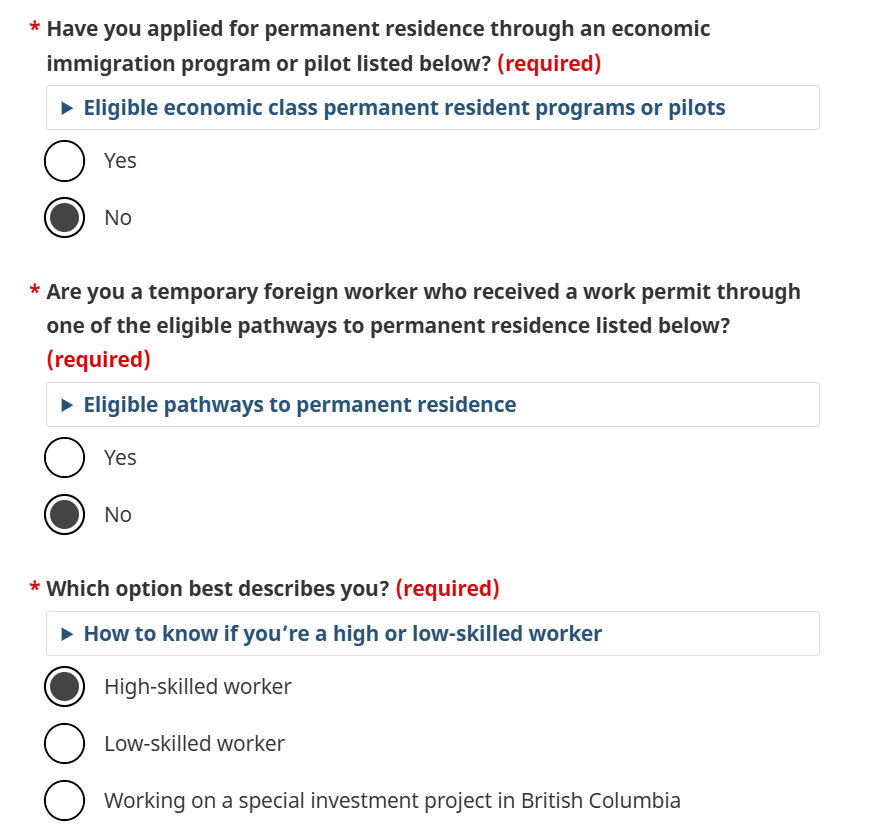
Please note, because the rules have changed recently, many immigration pages or third-party blogs may contain outdated information. Therefore, it is essential to only trust the most up-to-date sources.
Additional information about this LMIA exemption code C41 can be found >> here on the official IRCC website.
How much will it cost to apply for the Spousal Open Work Permit?
As of 2026, the following fees must be paid as part of the application:
- $155 work permit fee
- $100 open work permit holder fee
- $85 for biometrics when required
Does a SOWP count as an IEC participation?
No. A Spousal Open Work Permit is a separate immigration program and does not count as an International Experience Canada (IEC) participation.
How to Apply for a Spousal Open Work Permit
There are two options for applying for the Spousal Open Work Permit:
- Online, either from outside Canada or from within Canada.
- At the airport, when you arrive in Canada together from an international destination.
Instructions on how to apply as a partner of an IEC participant from inside Canada > here <
Relationship Requirements
Can we apply if we are only dating?
No. To qualify for a SOWP as a partner, you must be either:
- Legally married, or
- In a common-law relationship
What is a common-law relationship for a Spousal Open Work Permit?
For immigration purposes, common-law partners must have lived together in a marriage-like relationship for at least 12 consecutive months and be able to provide evidence of the relationship.
What is acceptable proof of 'genuine relationship'?
Depending on what your relationship is, one of the following must be provided:
- A copy of the marriage certificate translated into English or French. The original + translation must be provided
- Statutory Declaration of Common-Law Union (IMM 5409) form, that must be notarized
What can be used as proof of a 12-month common-law relationship?
You can use documents that show you have lived together and shared a household for at least 12 months, such as:
- A shared lease or rental agreement
- Joint utility bills (electricity, internet, etc.)
- Joint bank account statements
- Government-issued IDs showing the same address (for example driver’s licenses)
- Insurance documents listing the same address or each other as beneficiaries
- Mail or official correspondence addressed to both partners at the same residence
- Signed statutory declarations from third parties confirming cohabitation
- For example, if you lived with your parents, they can provide a letter confirming that you lived together at their address
What happens if our relationship ends after the SOWP is approved?
If your relationship ends after the Spousal Open Work Permit has been approved and issued, the permit does not automatically become invalid. Your partner can continue to live and work in Canada until it expires.
Work Rights on a Spousal Open Work Permit
Do I need an LMIA for a SOWP?
No. A Spousal Open Work Permit is LMIA-exempt. Employers are not required to go through the very expensive LMIA process for you. The LMIA exemption code is C41.
Can I change employers with a SOWP?
Yes. Because a SOWP is an open work permit, you can change employers at any time without applying for a new work permit.
Can I work anywhere in Canada on a SOWP?
Yes. A Spousal Open Work Permit (SOWP) allows you to work for almost any employer in Canada. You do not need a job offer, and you are not tied to a specific employer.
However, some work restrictions still apply.
What work restrictions apply to a Spousal Open Work Permit?
There will be a restriction, that applies to all work permit holders and will be printed on the bottom of the work permit:
“Not valid for employment in businesses related to the sex trade such as strip clubs, massage parlours or escort services”
In other words, it means you can’t work for employers, who offer striptease, erotic dance, erotic massages, or escort services. This restriction is a strict rule and cannot be removed from the work permit.
Can I work in healthcare/teaching/childcare?
In general, this restriction will be printed on the work permit:
“Not authorized to work in 1) child care, 2) primary or secondary school teaching, 3) health services field occupations.”
However, this restriction can be removed if you complete a medical exam as part of your application. You can read more about the medical exam on this page > on this page <.
Can I work multiple jobs at the same time?
Yes. Since the permit is open, you are allowed to work for multiple employers at the same time, as long as you comply with your permit conditions.
How long will the Spousal Open Work Permit be valid for?
The Spousal Open Work Permit is directly linked to your partner’s work permit. For instance, if your partner has a 2-year work permit, you will also receive an open work permit for the same duration.
My passport is not valid long enough
The work permit cannot be issued beyond the expiry date of your passport. In other words, if your passport is only valid for another 8 months, your open work permit will be limited to that same 8-month period.
However, if your Spousal Open Work Permit was issued for a shorter duration due to your passport’s expiry, you can extend the work permit to match the maximum duration of your partner’s work permit.
To do so, you must first apply for a new passport. Additionally, there are two very important requirements to keep in mind:
- You must be in Canada.
- You must apply for the extension before your initial work permit expires.
Employment Requirements
How long do I need to be employed before my partner can apply for the SOWP?
IRCC does not mention a minimum length of employment requirement. However, you must provide sufficient evidence that you are actively employed in an eligible occupation. Supporting documents may include:
- An employment letter
- A signed employment contract
- Recent pay slips
Providing multiple documents can help strengthen the application.
Important note for airport applications
If you are applying at the airport after leaving and re-entering Canada, be aware that border officers may still ask for additional proof of employment.
Some applicants report being asked for recent pay slips. While this is no longer listed as an IRCC requirement, border officers can still request extra documents to confirm that you are currently working in an eligible job.
What if my job is not on the eligible TEER list?
Not all occupations qualify for a Spousal Open Work Permit. You should first check the requirements listed at the beginning of this FAQ section.
If your job is not included in the eligible TEER categories, your partner is not eligible for this type of work permit.
Does the job have to be a full-time job?
No. It can also be a part-time job.
Can my partner apply before I find a qualifying job?
No. Having an IEC work permit alone is not enough. At the time of the SOWP application, you must already be working in an eligible occupation and provide proof of employment.
What if I quit or change jobs?
You must be working in an eligible occupation when your partner applies for the Spousal Open Work Permit.
If you change jobs while the application is being processed, you must inform IRCC and provide your new job details. The new job must still meet the TEER requirements.
For example, your spouse applies for a Spousal Open Work Permit because you have an eligible job in TEER 1. You would like to change jobs because the current employer relationship doesn’t work out.
- If the application is still being processed:
If you change jobs to a position that is not eligible (for example, a TEER 4 job), you no longer meet the eligibility requirements. This could lead to the SOWP application being refused.
- If the application is approved:
Once the SOWP is approved and issued, it will not be affected if you quit your job or change employers. The work permit remains valid until the expiry date printed on it.
Timing, Travel & Special Cases
Is there an age limit for a Spousal Open Work Permit?
No, there is no age requirement for this work permit. The Spousal Open Work Permit (SOWP) is separate from the International Experience Canada (IEC) program, so your spouse can be any age when applying.
Are there any country restrictions for a Spousal Open Work Permit?
No. There are no nationality or country restrictions for SOWP.
Unlike the International Experience Canada (IEC) program, which is only available to citizens of participating countries, a SOWP is based on the relationship (spouse/common-law partner), and whether the three eligibility requirements are met.
Can we apply for the Spousal Open Work Permit at the US border via flagpoling?
Unfortunately, this is no longer an option. The Canadian government ended flagpoling on December 24, 2024. The official announcement can be found > here <.
There are now two options:
- If your partner is already inside Canada, they must apply online. Online processing can take several months.
- If you are looking for a faster option, both of you can travel to another country (outside the United States) and re-enter Canada by air, where your partner may apply at the airport.
- If approved, the work permit will be issued on the spot.
- In this case, you must bring the same required documents and supporting proof as you would for an online application.
Note: If you plan to apply for the SOWP at the airport after arriving in Canada from abroad, be aware that border officers may request proof of health insurance even for the SOWP. Several applicants have reported this in their experiences.
You could look into > BestQuote < which is a Canadian broker that has quite a few affordable policies to choose from.
Do I have maintained status when I apply for the SOWP online?
If you are already in Canada with another work permit you must apply for the Spousal Open Work Permit (SOWP) online before the expiry of your existing work permit.
Once you have applied for the Spousal Open Work Permit (SOWP), you can benefit from what is known as “maintained status” (starting from the expiry of your current work permit). This means that you can continue working until a decision is made on your SOWP application.
However, during maintained status, you can only continue to work under the same conditions as your expired work permit.
- If you’re in Canada on a Working Holiday work permit (an open work permit), you are permitted to work for any employer.
- If you are in Canada with a closed work permit that is tied to a specific employer, you are not allowed to change employers. You can only do so after the Spousal Open Work Permit is approved and mailed to you.
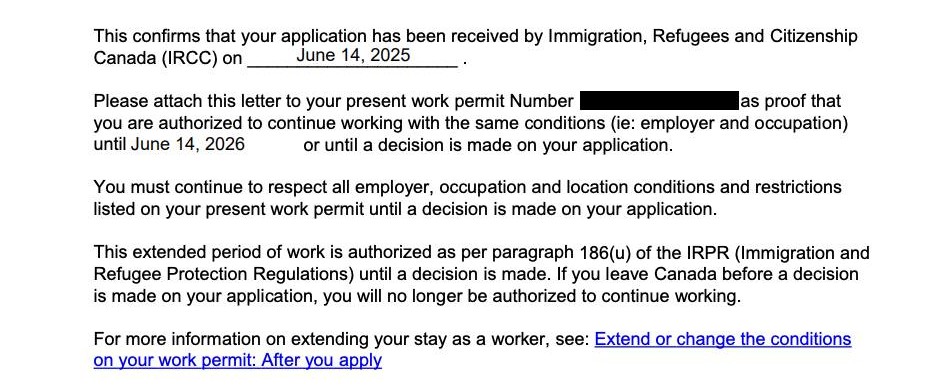
Very important!
If you apply for the Spousal Open Work Permit after your current work permit has already expired, you will not benefit from maintained status. This means you cannot work again until your new Spousal Open Work Permit has been approved and issued.
Can I leave Canada while I wait for the decision on my Spousal Open Work Permit?
Yes, you can leave and return to Canada as long as your current work permit is still valid.
However, once your maintained status begins (after your work permit expires), you should not leave Canada, as you will lose that status.
If you re-enter Canada after your work permit has expired, you can only enter as a visitor, which means you cannot work anymore until your new work permit is approved.
Do I also need health insurance for the Spousal Open Work Permit (SOWP)?
No, health insurance is not mandatory for the Spousal Open Work Permit (SOWP). However, it is highly recommended to have insurance, as medical expenses in Canada can be extremely high.
Because the Spousal Open Work permit is not part of the IEC program anymore, most IEC health insurance providers won’t offer coverage.
Reminder: If you plan to apply for the SOWP at the airport after arriving in Canada from abroad, be aware that border officers may request proof of health insurance. Several applicants have reported this in their experiences.
You could look into > BestQuote < which is a well known Canadian broker that has quite a few affordable policies to choose from. I recommend getting a quote from BestQuote and asking them any questions you might have.
Job List in TEER 2
- 22100 – Chemical technologists and technicians
- 22101 – Geological and mineral technologists and technicians
- 22110 – Biological technologists and technicians
- 22111 – Agricultural and fish products inspectors
- 22112 – Forestry technologists and technicians
- 22113 – Conservation and fishery officers
- 22114 – Landscape and horticulture technicians and specialists
- 22210 – Architectural technologists and technicians
- 22211 – Industrial designers
- 22212 – Drafting technologists and technicians
- 22213 – Land survey technologists and technicians
- 22214 – Technical occupations in geomatics and meteorology
- 22220 – Computer network and web technicians
- 22221 – User support technicians
- 22222 – Information systems testing technicians
- 22230 – Non-destructive testers and inspectors
- 22231 – Engineering inspectors and regulatory officers
- 22232 – Occupational health and safety specialists
- 22233 – Construction inspectors
- 22300 – Civil engineering technologists and technicians
- 22301 – Mechanical engineering technologists and technicians
- 22302 – Industrial engineering and manufacturing technologists and technicians
- 22303 – Construction estimators
- 22310 – Electrical and electronics engineering technologists and technicians
- 22311 – Electronic service technicians (household and business equipment)
- 22312 – Industrial instrument technicians and mechanics
- 22313 – Aircraft instrument, electrical and avionics mechanics, technicians and inspectors
- 32100 – Opticians
- 32101 – Licensed practical nurses
- 32102 – Paramedical occupations
- 32103 – Respiratory therapists, clinical perfusionists and cardiopulmonary technologists
- 32104 – Animal health technologists and veterinary technicians
- 32109 – Other technical occupations in therapy and assessment
- 32110 – Denturists
- 32111 – Dental hygienists and dental therapists
- 32112 – Dental technologists and technicians
- 32120 – Medical laboratory technologists
- 32121 – Medical radiation technologists
- 32122 – Medical sonographers
- 32123 – Cardiology technologists and electrophysiological diagnostic technologists
- 32124 – Pharmacy technicians
- 32129 – Other medical technologists and technicians
- 32200 – Traditional Chinese medicine practitioners and acupuncturists
- 32201 – Massage therapists
- 32209 – Other practitioners of natural healing
- 42102 – Specialized members of the Canadian Armed Forces
- 42202 – Early childhood educators and assistants
- 72010 – Contractors and supervisors, machining, metal forming, shaping and erecting trades and related occupations
- 72011 – Contractors and supervisors, electrical trades and telecommunications occupations
- 72012 – Contractors and supervisors, pipefitting trades
- 72013 – Contractors and supervisors, carpentry trades
- 72014 – Contractors and supervisors, other construction trades, installers, repairers and servicers
- 72020 – Contractors and supervisors, mechanic trades
- 72021 – Contractors and supervisors, heavy equipment operator crews
- 72022 – Supervisors, printing and related occupations
- 72023 – Supervisors, railway transport operations
- 72024 – Supervisors, motor transport and other ground transit operators
- 72025 – Supervisors, mail and message distribution occupations
- 72100 – Machinists and machining and tooling inspectors
- 72101 – Tool and die makers
- 72102 – Sheet metal workers
- 72103 – Boilermakers
- 72104 – Structural metal and platework fabricators and fitters
- 72105 – Ironworkers
- 72106 – Welders and related machine operators
- 72200 – Electricians (except industrial and power system)
- 72201 – Industrial electricians
- 72202 – Power system electricians
- 72203 – Electrical power line and cable workers
- 72204 – Telecommunications line and cable installers and repairers
- 72205 – Telecommunications equipment installation and cable television service technicians
- 72300 – Plumbers
- 72301 – Steamfitters, pipefitters and sprinkler system installers
- 72302 – Gas fitters
- 72310 – Carpenters
- 72311 – Cabinetmakers
- 72320 – Bricklayers
- 72321 – Insulators
- 72400 – Construction millwrights and industrial mechanics
- 72401 – Heavy-duty equipment mechanics
- 72402 – Heating, refrigeration and air conditioning mechanics
- 72403 – Railway carmen/women
- 72404 – Aircraft mechanics and aircraft inspectors
- 72405 – Machine fitters
- 72406 – Elevator constructors and mechanics
- 72410 – Automotive service technicians, truck and bus mechanics and mechanical repairers
- 72411 – Auto body collision, refinishing and glass technicians and damage repair estimators
- 72420 – Oil and solid fuel heating mechanics
- 72421 – Appliance servicers and repairers
- 72422 – Electrical mechanics
- 72423 – Motorcycle, all-terrain vehicle and other related mechanics
- 72429 – Other small engine and small equipment repairers
- 72500 – Crane operators
- 72501 – Water well drillers
- 72600 – Air pilots, flight engineers and flying instructors
- 72601 – Air traffic controllers and related occupations
- 72602 – Deck officers, water transport
- 72603 – Engineer officers, water transport
- 72604 – Railway traffic controllers and marine traffic regulators
- 72999 – Other technical trades and related occupations
- 82010 – Supervisors, logging and forestry
- 82020 – Supervisors, mining and quarrying
- 82021 – Contractors and supervisors, oil and gas drilling and services
- 82030 – Agricultural service contractors and farm supervisors
- 82031 – Contractors and supervisors, landscaping, grounds maintenance and horticulture services
Job List in TEER 3
- 33100 – Dental assistants and dental laboratory assistants
- 33101 – Medical laboratory assistants and related technical occupations
- 33102 – Nurse aides, orderlies and patient service associates
- 33103 – Pharmacy technical assistants and pharmacy assistants
- 33109 – Other assisting occupations in support of health services
- 43100 – Elementary and secondary school teacher assistants
- 43204 – Operations Members of the Canadian Armed Forces
- 53200 – Athletes
- 53201 – Coaches
- 73100 – Concrete finishers
- 73101 – Tilesetters
- 73102 – Plasterers, drywall installers and finishers and lathers
- 73110 – Roofers and shinglers
- 73111 – Glaziers
- 73112 – Painters and decorators (except interior decorators)
- 73113 – Floor covering installers
- 73200 – Residential and commercial installers and servicers
- 73201 – General building maintenance workers and building superintendents
- 73202 – Pest controllers and fumigators
- 73209 – Other repairers and servicers
- 73300 – Transport truck drivers
- 73301 – Bus drivers, subway operators and other transit operators
- 73310 – Railway and yard locomotive engineers
- 73311 – Railway conductors and brakemen/women
- 73400 – Heavy equipment operators
- 73401 – Printing press operators
- 73402 – Drillers and blasters – surface mining, quarrying and construction
- 83100 – Underground production and development miners
- 83101 – Oil and gas well drillers, servicers, testers and related workers
- 83110 – Logging machinery operators
- 83120 – Fishing masters and officers
- 83121 – Fishermen/women