How Much Money Should I Bring to Canada on an IEC Working Holiday?
One of the most common questions from International Experience Canada (IEC) participants is:
“How much money should I bring to Canada?”
While there is a minimum amount required by the Canadian government, most newcomers quickly discover that bringing only the minimum can make the first few weeks stressful.
Do I need proof of funds for IEC Canada?
Yes. For International Experience Canada (IEC), which includes the Working Holiday, you need to prove that you have sufficient funds when you enter Canada to activate the work permit.
A border officer can ask to see your bank statement or bank letter when you arrive, and if you cannot show sufficient funds, your work permit may be refused.
What is the minimum amount required for an IEC?
To receive your IEC work permit when you arrive in Canada, you must show that you have at least CAD $2,500 available to support yourself during the beginning of your stay.
You must also have enough money to buy a return ticket, or already have a return ticket before entering Canada.
>> Find out what else you should prepare before travelling to Canada.
What documents can I use as proof?
Acceptable proof of funds usually includes:
- A recent bank statement
- An official letter from your bank showing your available balance
The money must be immediately accessible and in your name.
Can I bring cash?
Yes. You can bring cash to Canada, and it can count as proof of funds.
However, carrying large amounts of cash is generally not recommended. A bank statement or official bank letter is a safer and more practical way to show that you meet the financial requirement.
Bringing more than CAD $10,000 to Canada
There is no limit to how much money you can bring into Canada.
However, if you are carrying CAD $10,000 or more (or the equivalent in other currencies), you must declare it when you enter Canada. This only applies to money you physically bring with you, not funds held in a bank account.
This rule applies to cash as well as other monetary instruments such as bank drafts and traveller’s cheques. The declaration is part of Canada’s anti-money laundering regulations.
Is $2,500 CAD enough for IEC Canada?
Technically, yes. $2,500 is the minimum requirement for International Experience Canada (IEC), and you must be able to show this amount when you arrive in Canada.
However, it is usually not enough for a comfortable start.
In practice, many newcomers spend most of this money shortly after arrival on essential setup costs. Since finding housing and a job can take time, this budget often needs to cover several weeks or even months before the first paycheque.
Typical expenses after arriving in Canada
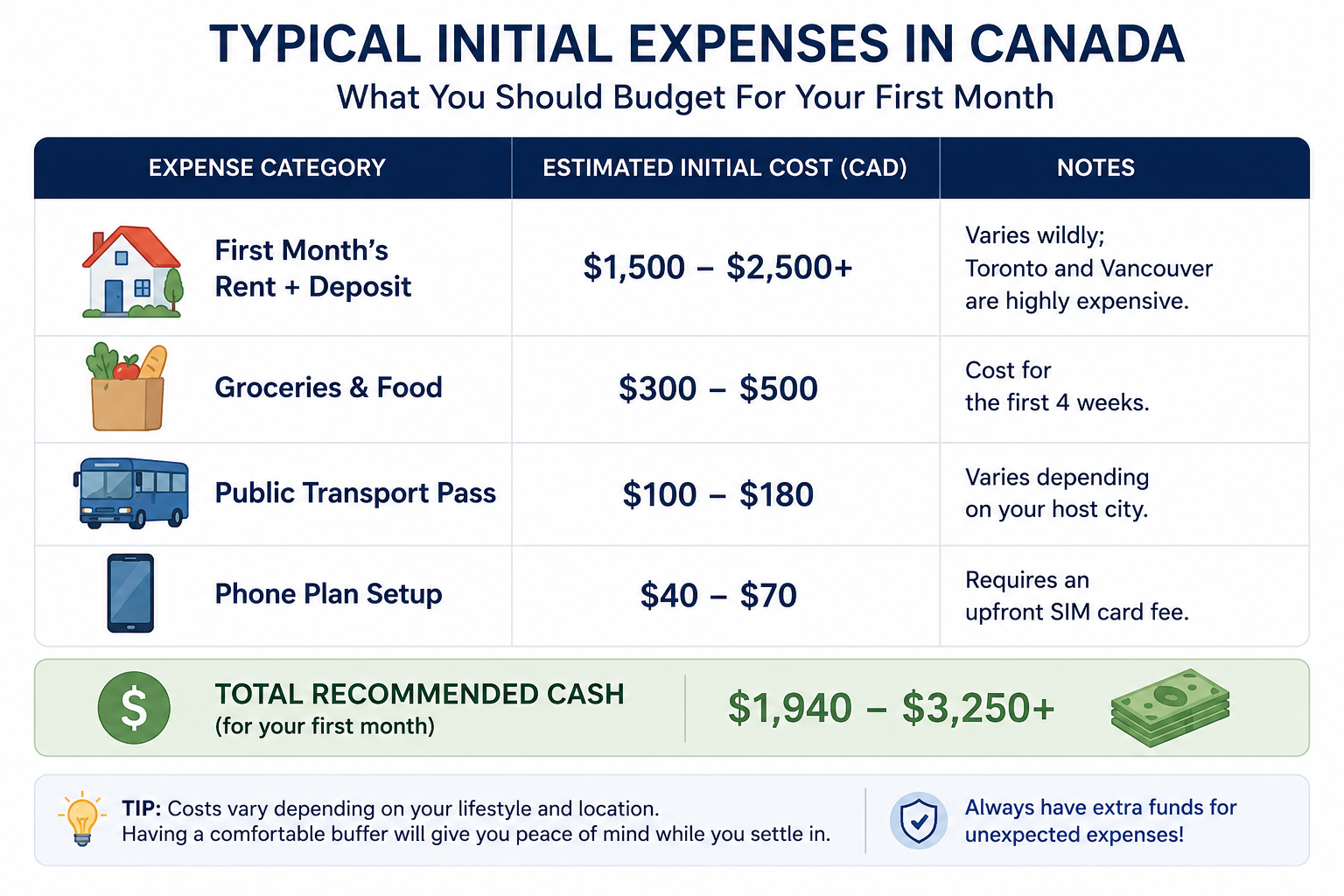
During your first month, you may need to pay for:
- Temporary accommodation
- Security deposit and first month’s rent
- Groceries
- Public transportation
- A Canadian phone plan
- Household essentials
- Entertainment and unexpected expenses
These costs can quickly exceed the government’s minimum requirement.
How your destination affects your budget
Not every city in Canada costs the same. Where you choose to live has a significant impact on how long your savings will last.
Cities such as Toronto and Vancouver are among the most expensive in Canada. A typical one-bedroom apartment can range from CAD $2,200 to $3,000+ per month, and even shared accommodation often costs CAD $900 to $1,500 per month per person.
In contrast, many smaller cities such as Calgary, Edmonton, Winnipeg, or Halifax are more affordable. In these locations, a one-bedroom apartment may cost around CAD $1,300 to $1,900 per month, and shared housing can be found for CAD $700 to $1,000 per month.
How much money should I actually bring?
The amount you should bring depends on your personal situation and where you’ll be living. If possible, arrive with more than the required minimum. Before travelling, research the cost of living in your destination and prepare a realistic budget.
Recommended savings if you already have accommodation
If you’ve already arranged housing before arriving, having CAD $4,000 to $5,000 is often enough to comfortably cover your first few weeks while you search for work.
Recommended savings if you need to find housing and a job
If you’ll be searching for both accommodation and employment after arriving, I recommend bringing at least CAD $10,000. This gives you a financial buffer in case it takes longer than expected to find a suitable accommodation or a job.
If you can find a job with staff accommodation included, that’s two birds with one stone, which is a great best-case scenario.
Buying a car in Canada
If you plan to buy a car shortly after arriving, you should budget significantly more. Even used cars require a larger upfront fund for the purchase price, insurance, registration, and initial maintenance costs. Having extra savings beyond the standard IEC recommendation is important, especially since transportation is often essential outside major city centres.
What if I am travelling with a partner or as a family?
The amount of money you’ll need depends not only on where you’re moving, but also on how many people you’re supporting.
If you’re travelling by yourself, your expenses are generally lower. You may be able to rent a room instead of an entire apartment and share living costs with roommates.
Travelling with a partner
Couples can save money by sharing rent and household expenses. However, you’ll still need enough savings to support both of you while one or both of you search for work.
If both partners are entering Canada under the IEC program, each person must ensure they meet the proof of funds requirement for their own work permit.
Travelling with children
Families should budget considerably more for housing, food, transportation, childcare, school supplies, and unexpected expenses. If you’re moving with a partner and children, I recommend bringing more than CAD $20,000 to help cover your initial costs and provide a financial buffer while you get settled.
In major cities like Vancouver and Toronto, a three-bedroom home can cost CAD $4,000 to $5,500 per month or more, so it’s important to plan your budget carefully before you arrive.
Emergency costs
No matter how carefully you plan, unexpected expenses can happen.
A delayed job offer, medical expenses not covered by insurance, emergency travel, or unexpected car repairs can quickly affect your budget. Having an emergency fund can help you manage these costs without added financial stress.
IEC health insurance and emergency costs
A mandatory requirement of the IEC program is health insurance that covers emergency medical care. However, it’s important to understand how it works in practice. For many unexpected medical expenses, you’ll need to pay upfront and then submit a claim to your insurer for reimbursement.
This means that even if you’re insured, you should have access to enough savings or available credit to cover hospital visits, prescriptions, or emergency treatment until you’re reimbursed. Depending on your insurance provider, reimbursement can take several days or even weeks.
>> Find out more about the IEC health insurance requirements.
Bring a credit card for emergencies
In addition to your savings, it’s a good idea to bring a credit card with enough available credit to cover unexpected expenses.
Ideally, choose a card that:
- Has no foreign transaction fees (if available)
- Offers travel or emergency medical coverage
- Includes rental car or trip interruption insurance if you plan to travel
- Has a sufficient credit limit for genuine emergencies
A credit card shouldn’t replace your savings, but it can be extremely helpful if you face an unexpected expense before you’ve started earning an income in Canada.
Frequently Asked Questions

Does the money have to be in Canadian Dollars?
No. Your money does not have to be in Canadian dollars. It can be in another currency, as long as its value is at least the required amount in Canadian dollars.
When you arrive in Canada, the border officer may convert the amount using the current exchange rate to make sure you meet the financial requirement. If your balance is close to the minimum, it’s a good idea to have a little extra to allow for exchange rate fluctuations.
How old can my bank statement be?
According to IRCC >> IEC guidance here, your bank statement (or bank letter) must be issued no more than one (1) week before your departure for Canada. It must clearly show your name and your available funds.
Does my bank statement need to be in English?
Not necessarily. However, border officers need to be able to understand your documents.
Your bank statement should clearly show that it is from a bank, include your name, and show your available balance. If these details are not easy to understand because the statement is in another language, bringing a certified English or French translation is recommended.
Can I show my bank balance in my online banking app?
It’s not a good idea to rely on your online banking app as proof of funds when you arrive in Canada.
There are many reasons why you might not be able to access your account, for example:
- Your phone battery is dead.
- You don’t have Wi-Fi or mobile service.
- Your banking app doesn’t work outside your home country.
- Two-factor authentication doesn’t work because your phone number isn’t available.
Even if you can access your account, some border officers may prefer to see printed documents instead of a phone screen.
It’s also possible that the officer will collect your passport and paperwork and ask you to wait while they review your application. In that case, you won’t have access to your phone to show your bank balance.
To avoid any problems, bring a printed bank statement or an official bank letter showing your available funds. Being prepared can make the process at the border much smoother.
Can I use a credit card as proof of funds?
No. A credit card or available credit is not considered proof that you have the required funds.
What happens if I don't have enough money?
If you are unable to show that you meet the IEC financial requirements, a border officer may refuse to issue your work permit.
Can my parents show their bank account instead?
No. The funds must be available to you and in your name. Your parents can support you while you’re in Canada, but when you activate your work permit, border officers need to see that you can financially support yourself.
Can I use Wise or Revolut as proof of funds for the IEC?
Yes. You can use a Wise or Revolut account as proof of funds if the money is available to you and the account is in your name.
To avoid any problems at the border, bring a recent printed account statement showing your name and available balance. It’s better not to rely only on the online account apps, as you may not have access to your phone or internet when speaking with the border officer.
Can I show the money in my savings or investment account?
Yes. You can use funds from a savings account or investment account as proof of funds, as long as the money is accessible and can be withdrawn if needed.
However, the key requirement is that the funds must be readily available. This means:
- Money in a regular savings account is acceptable
- Money in a checking/current account is acceptable
- Investments (such as stocks, ETFs, or mutual funds) may be accepted only if they can be quickly liquidated
If your funds are in an investment account, it is strongly recommended to also provide documentation showing the current value and proof that you can access or withdraw the money without restrictions.
Border officers mainly want to see that you can support yourself financially after arriving in Canada, not just that the money exists on paper.